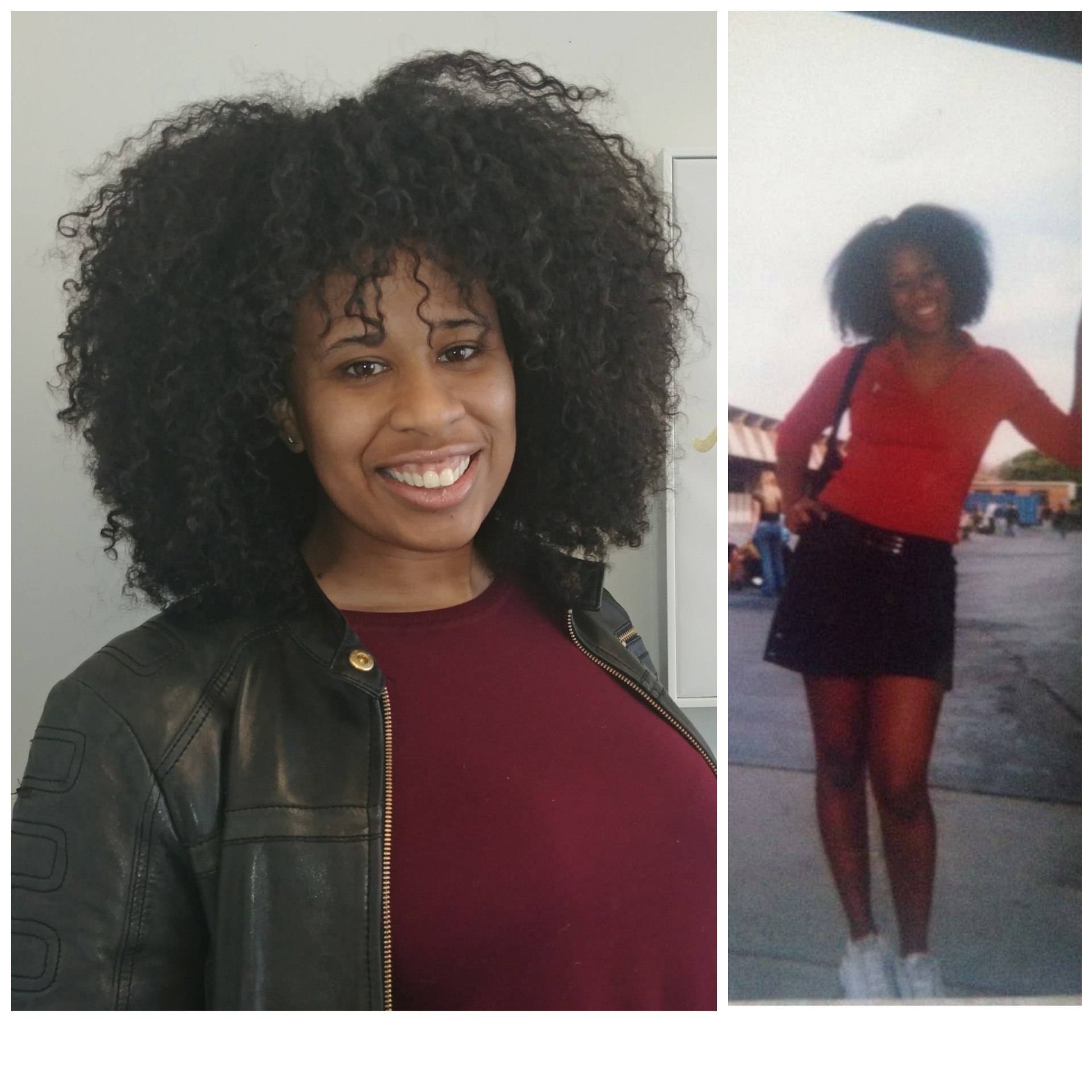
I wear my hair naturally curly. To some this doesn’t mean much but as a Women of Colour (WOC), you could say it takes courage to rock one’s born given hair texture. I have given a lot of thought to the natural hair movement: A movement that encourages Black women and women of African ancestry to embrace their natural kinks, curls and coils. As a mixed woman, I know that my relationship with my hair has been complicated and that it took time for me to embrace my 3C curl pattern.
Over the years, my hair has been relaxed, texturized, blow dried and flat ironed in the pursuit of straight, long hair. I did this because there was a time in my life that I thought I looked better with straight hair. But the energy, time and cost it took to maintain my straight hair became exhausting. Plus there was the constant shade I received from my mom when I wore my hair straight with comments like “you just don’t look like you”, attributed to my subconscious decision to accept my natural curls. In doing so, I felt like I also made a choice to accept myself.
As the natural hair movement began to gain momentum in the United States and Canada in the early 2000s and the rise of YouTuber’s giving on-line tutorials and promoting products on how best to manage natural hair, I felt missing from the conversation was why Black women were choosing to wear their hair natural. Hence, I begin The Hair Stories Project. The goal is to explore why Black and Mixed women decided to go natural. Through my lived experience I know my hair journey has been both a painful and rewarding one. I wanted to find out what it was like for other Women and girls navigating through self-discovery and re-defining their perception of beauty within the dominant (White) society.
I have had the opportunity to interview some phenomenon women and girls (some are my family) who have decided to go au naturale. The project asks three questions: Why did you decide to wear your hair natural? What do you like about your hair? And what do you dislike about your hair? These are simple questions but it uncovers deeper issues of self-esteem and self-acceptance.
I thank each one of these amazing ladies for sharing their stories. It is my intent these stories will shed light on the beauty double standards of WOC – particularly Black women in a Canadian society that at times, is not as accepting as we think.
“Wearing my hair natural and cut short is an act of rebellion that a lot of people wouldn’t understand.”
MARCIE BURKE (Mother of Aoife)
Age: 50
Occupation/field: Accounting
Ethnicity: Jamaican
Scarborough, ON
Why did you decide to go natural?
Wearing my hair natural and cut short is an act of rebellion that a lot of people wouldn’t understand. As a child my Mom would spend hours and hours at the hair salon getting her hair braided. She would say “your hair is your crowning glory.” Back then the braids would be done so tight to the scalp. Over the years the stress of the braids has damaged my Mom’s hair to the point where the edges around her hairline have broken off. It’s almost like she was saying you had to do certain things to be considered attractive. She was a product of her very West Indian upbringing. As a teenager I remember thinking that I didn’t want to spend so much time on my hair. That’s where the rebellion comes in. My mom has spent thousands and thousands of dollars on her hair over the years. Growing up we were not a middle class family. We were one step up above poor but mom getting her hair done was so accepted. It’s based on the conception that a woman, especially Black women, must leave the house well put together.
In West Indian culture, it is ingrained in you but it takes a lot (time, energy and money) to achieve. It is a culture where everything stops on a Saturday because Mom had to get her hair done – and my father was on board. He did not question it. Looking back, I think what we could have done with the money my Mom spent on her hair. However, on the plus side I learned from my mother to take the time to do things to pamper yourself. In today’s society women are now encouraged to do nice things for themselves and not feel guilty. I was fortunate enough to learn that lesson from my mother when I was very young: put your family’s needs before yours but don’t feel guilty about doing something nice for yourself. For my mother it was getting her hair done.
What do you dislike about being natural?
How society sees you. You are the other. You are not in the mainstream and not the idea of mainstream beauty. It’s almost like you’re invisible – being invisible as a Black woman and invisible as a Black woman with short natural hair. There is a certain assumption about you (having short natural hair) people think that you are a lesbian. I think that is changing though. It does take a lot of courage to go out in the world with short hair. It’s kind of like you are saying what you see is what you get.
Recently, I walked into a restaurant and there was this African man with dreadlocks and he said to me “I love your natural hair.” Then he went into a rant about Black women not showing their true beauty by wearing weaves and wigs. He said it was a sin to God by wearing fake hair instead of your natural-born hair. He went on to say that Black women are getting their hair done – wearing weaves and wigs but their kids are going hungry. Clearly he had issues. I don’t think just because a Black woman decides to wear a wig or a weave she should be ripped apart for it. There are a lot of celebrities who wear weaves, like Beyoncé, to get long hair and it is accepted even required.
Why do you like about wearing your hair natural?
This is me. I like wearing my hair natural and short because it reflects my personality. I am not high maintenance and this is as low maintenance as you can get. It is a true wash and go hairstyle. I get my hair cut every three to four weeks – maximum five-week or it grows into a little afro and no one wants to see that. “I want to see that” said daughter Aoife. By me having my hair natural and short, it doesn’t take any time at all to look presentable–just brush and go, so the extra time allows me to help Aoife manage and style her natural curls. Which does take some time.
“Even though I know it’s up to me to decide how I wear my hair, I know it makes a big difference in how people see you.”
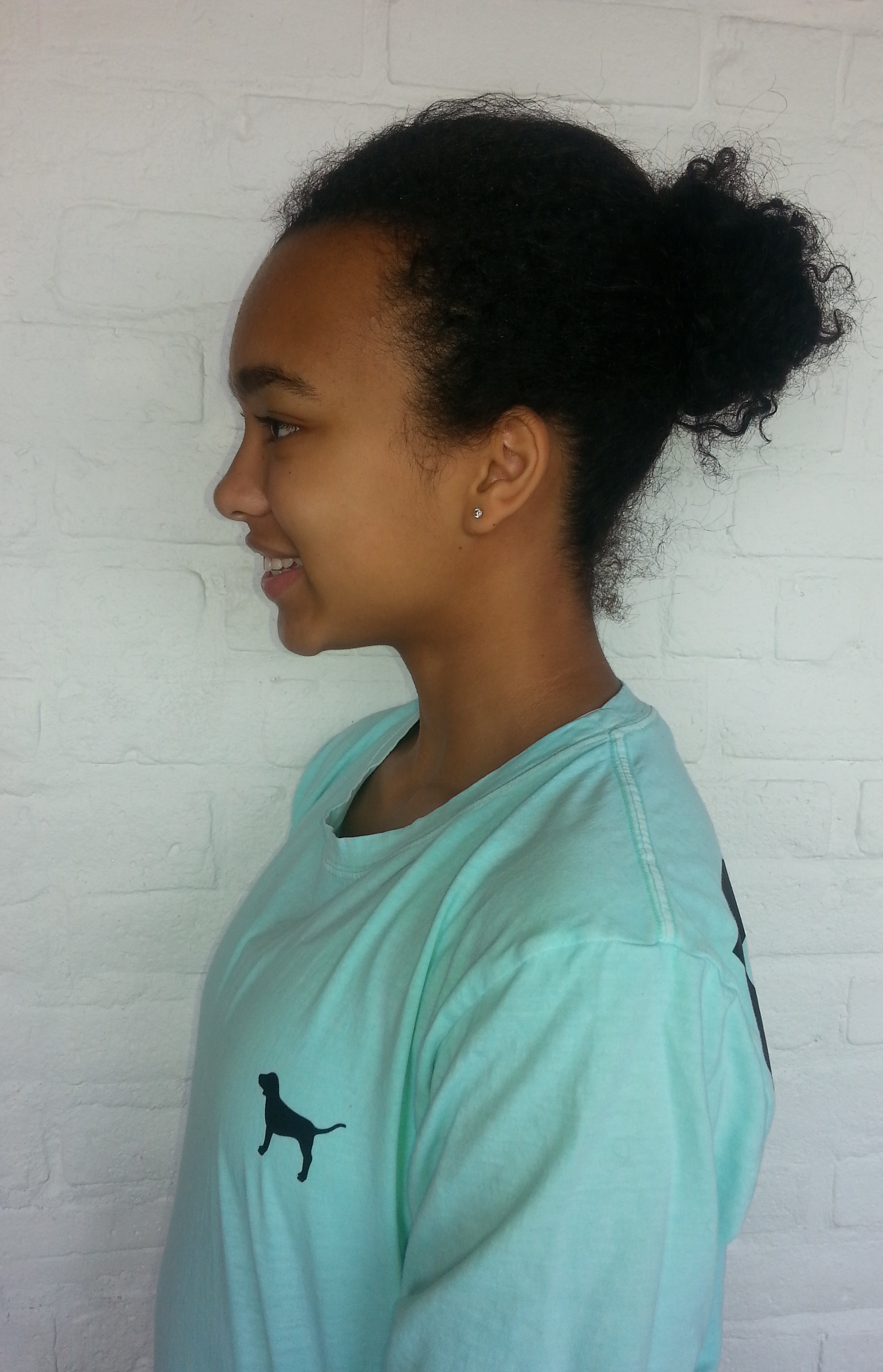
AOIFE (pronounced “Eefa”) DOYLE
(daughter of Marcie Burke)
Age: 15
Occupation: High school student
Ethnicity: Jamaican and Irish
Scarborough, ON
Why did you decide to go natural?
I started wearing my hair natural just in the last few months. It sort of happened organically. I had been having my hair blow dried straight for a few years and just wanted to try it curly. It was a difficult decision for me because some people like it curly and some people like it straight. Even though I know it’s up to me to decide how I wear my hair, I know it makes a big difference in how people see you. There are both pros and cons of wearing my natural curls verses blow drying my hair straight. I have school and play rep hockey which takes up a huge amount of time, so that really dictates how much time I have for my hair. When I was younger my mother would put my hair in a braid so it could fit under my helmet when I played hockey. We called it the “hockey braid”. Eventually my mom found a great hair stylist and we would go to the salon and get it blow dried straight on occasion or before a picture day at school. This started around grade 3. The salon visits would have to be worked around my hockey practices. I could not and would not miss a hockey practice or game to get my hair done. That was not allowed. My mom felt it was a good alternative to manage my hair and keep it healthy. She insisted on not using any chemicals or relaxers in my hair because they are known to really damage the hair. I started asking for my hair to be regularly blown out in grade eight because I wanted a change and because I felt it made me look more mature and grown up. It was also easier to handle and less time consuming (need the time for hockey) when it was blown out
Starting high school has also helped me to embrace my natural hair. The fact of being in a new school that is multicultural and diverse encouraged me to embrace the uniqueness of my hair. Also around that time my father, who is Irish, walked out and it brought me closer together with my Mom–I began to want to find out more about her heritage. The elementary and middle schools I went to were predominately white and I had mostly white friends. I didn’t think about embracing my Jamaican heritage then because all I wanted to do was fit in. Now at high school standing out is a good thing. I am bi-racial and I am in the gifted program. At school, people don’t say “I’m mixed” or “she’s mixed” but “she’s light skinned”. I am the only “light skinned” girl at my high school that is both academically and athletically strong.
What do you dislike about being natural?
There is not a lot of variety of hairstyles to choose from. It requires more maintenance because it gets knotted and it takes time to get it under control. Frizz is the enemy. Frizz does not look good. I went to my school’s Athletic Banquet and I wore my hair curly, half up half down. It was formal but I couldn’t leave my hair fully down because I was afraid it would totally frizz up. My hair has different textures. The upper part of my hair is frizzier than the bottom part of my hair. There was a dance floor so I had to consider how the humidity, after dancing all night, would impact my hair. I have to think what style would look best for the longest amount of time. Some people said I should have made it curly but they don’t know what it will be or look like at the end of the night. Their imagination of it isn’t my reality.
What do you like about being natural?
I feel special. There are a lot of people who have straight hair but I feel I stand out with my curly hair. Also straight hair does not fully connect me to my ethnicity. Wearing my hair natural allows me to connect to another part of who I am. It’s another part of me where people can recognize I am mixed. In the summer, when I go to pool parties, I don’t have to worry about my hair as opposed to when I have my hair straight and have to worry about it getting wet because it will go curly when I don’t want it curly. My mother wears her hair natural and in a short cut. It is low maintenance and doesn’t take a long time to style. For Black women it’s never just about hair – it’s so much more.
I started my natural hair journey four years ago when I decided to texturize my hair. For me, at the time, I thought that was the easiest way to transition to natural hair. I found the experience to be overwhelming both personally and professionally. From a personal standpoint, I didn’t realize it at the time, but I did not have the support system to go natural. Sounds crazy saying that aloud, to think one would need a “support system” to change their hair style. For just about my entire life, I wore my hair in braids or got a perm to straighten it.
My Mom would say “your hair is your beauty”. This comment implied the longer and straighter your hair is, the more beautiful you are. She didn’t like the look of natural hair and couldn’t understand why anyone, including me would want to go natural. There is a stigma with Black woman and their natural hair: That somehow there inability to conform to commercial beauty standards, makes them less attractive and even somewhat of an outlaw. I define “commercial beauty” as Black women adopting a more Eurocentric look to be accepted in society. This plays into the stereotype, within the Black community, of “good hair” being considered long, and straight, and anything else seen as “bad hair.” Chris Rock made a documentary called “Good Hair” some years ago exploring why Black women wore extensions, wigs and weaves. There is also history of Black women straighten their hair to find work and gain social mobility, especially in a corporate work environment. This all plays into the reason why when going natural, you need a support system.
When I transitioned to a more natural texture, it was hard to find the right product to maintain my hair so I ended up purchasing tons of products I didn’t need and that actually damage my hair partially due to the ingredients.
I got a lot of stares and questions from work colleagues, asking “why did you change your hair?” I felt like I was treated differently at work. It was almost as if, I was no longer the exception, and somehow had become too Black. Who would have thought, hair had such power?
I work in the corporate world for a leading Fortune 500 company as a Senior Manager in logistics. Despite my field being extremely male dominated, I have found success in my role by working hard. With that said, it has been a difficult and isolating journey navigating my way up the corporate ladder as a young Black female from the Caribbean. I just wanted to blend in and not stand out in any way. So, my hair was always straight and I made sure my clothing was always professional for the office.
I was also in a relationship, when I first decided to go natural, and I knew my partner might not like it. So, I chose to texturize my hair instead. Funny thing is, he didn’t actually tell me not to go natural, and maybe he would have been supportive, but at that point in my life, I was simply not ready to find out.
Overall, I found this experience challenging: It was hard enough being a woman in a male dominated field, much less having to deal with the intersection of race, my hair and worrying about how I am going to be perceived by mainstream society.
In March of this year, I decided to go fully natural, no chemicals and 100% natural hair products. The turning point for me was my health. I wasn’t in good shape, I was stressed, my iron was really low among other things and it caused my hair to fall out. Low iron is very common for most women but mine was extremely low to the point I had to go to the hospital for iron infusions. My doctor told me that my low iron could lead to other serious health conditions so I had to make some changes fast on how I cared for myself. I started working out two times a week, eating healthy foods – more fruits and veggies, drinking LOTS of water and putting a cap on working late nights at the office. Just by making those changes, I noticed a difference in my hair. It was healthier, stronger, and the colour was rich and dark. I no longer had to dye it for the colour to be vibrant.
I remember the day I went to my hair stylist and told her my story; her response was simply “why don’t you just go natural?” In that moment I knew it was time for a change, so I decided to take a leap of faith and went 100% natural. My hair stylist gave me a great cut and with the positive changes I made to my diet, going to the gym more often, and reclaiming time (less long nights at the office) my hair flourished. Once I stopped fighting my hair and accepted it, I was able to learn what products worked best for me.
One thing I want to highlight to anyone considering going natural is you do not need a lot of product. In fact, you need less than you think. If you know your hair and what works for your curl pattern, you just need the right foundation to bring out your natural curls. That includes water for hydration, oil for moisture, and a styling gel for definition. The product you use on your hair is so important. You could put tons of products in your hair and it may result in just making your hair feel and look awful. Then you may think this is just how my hair is. But it’s not your hair; the problem is you are not using the right products.
To tell you the truth, I find it a lot easier to care for my natural hair vs when it was straight. Another benefit is it is more affordable to maintain compared to the weekly trips to the salon for a blow dry or chemical touch ups when I was straighten my hair.
Once I made the decision to go natural this time I owned it! It wasn’t about what other people thought. It was about what was best for me and my health. What I noticed by accepting my hair, is that it allowed other people to accept it too. I received compliments on my hair from my co-workers and even my Mom loves it; So much so, that she decided to go natural. I learnt through this experience that my hair is not my identity. It is just hair!
I really wanted to share my story to help other young women trying to find themselves and own their identity, especially in the corporate world. You should not have to comprise yourself or your hair to be successful in the workforce. It is possible to be a leader in your field and be your true self.
What do you love about your Hair?
I love that is versatile and has a life/energy of its own. If you were to look at all the shades and textures of Black women, it is truly stunning. We are beautiful.
What do you dislike about your Hair?
I dislike the frizz and shrinkage, but on a good hair day, this isn’t a problem at all.
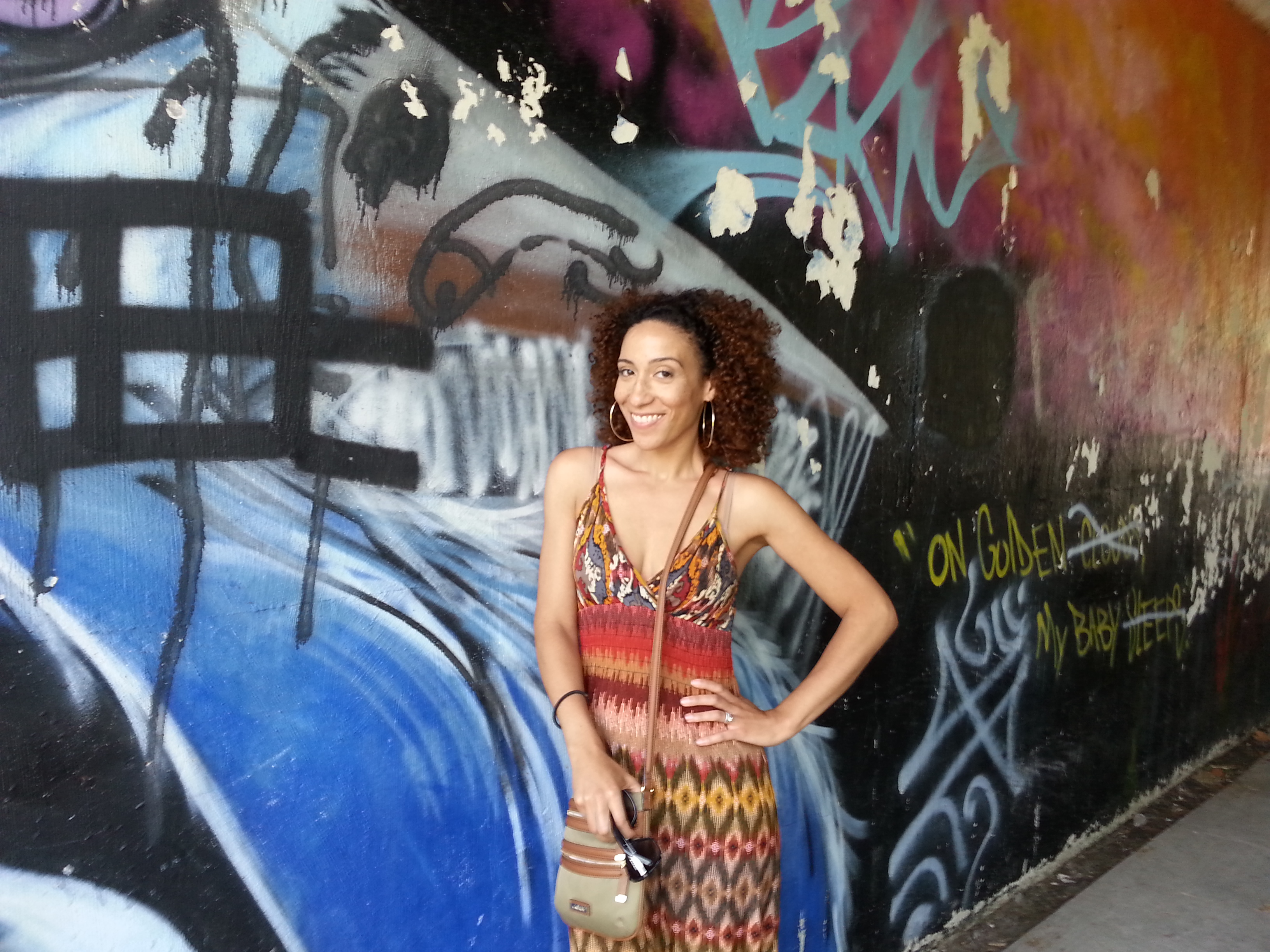
Ethnicity: Mixed: Jamaican, Canadian, British and German
Toronto, ON
Why did you
decide to go natural?
I decided to go natural about six years
ago. I had just started Ryerson University and I noticed a lot more
inter-racial and black women embracing their natural hair. Seeing this, coupled
with me growing as a person and becoming more confident in my own skin, made me
transition to natural hair styles. Wearing my hair in a ponytail, bun, half
up/half down or braids felt more like me, than wearing my hair straight. I am
still not 100% comfortable with wearing my hair fully down because I have like
six different curl patterns, so my hair can look very choppy (almost mullet-ish
lol) when down.
Mackenzie (my sister) and I are very close and our hair is always a
hot topic of conversation. I realize I have to accept how my hair is in its
natural state. You see all these girls with long straight hair and having a White
mom with long blond hair, who didn’t know how to do curly hair and being raised
around mainly White people, I started to feel like I hated my hair. At this point in my life, I am learning to
accept myself. That means loving all parts of me including my hair. I am still
figuring out my hair journey and although I wear my hair natural, I do like to
change up my hair styles every now and then. Sometimes I wear it in braids if I want the
length but it’s just that my hair is never going to be long and straight.
In the past, I straighten my hair with a flat iron but it would last all of 30 minutes before it
turned frizzy. I would put all this work into straightening it and it didn’t
even look good. Also straighten damages my hair and leaves my hair limp so I
decided to begin wearing it naturally curly.
What do you
dislike about being natural?
I am still struggling to find that right curly hairstyle that suits
me. Some days I wake up and I am so happy my hair has grown half an inch. Other
days, I wake up and feel that I would be happy to shave off all my hair because
it is such a struggle. Many times, when
I need to get out the door in a rush, I just put it in a sleek bun.
For natural hair there is a lot of preparation involved. For example,
if I am going on vacation and it’s a humid climate, with ocean beaches my first
thoughts are what am I going to do with my hair? I know these conditions can be
tough on my hair so I have to plan ahead.
Should I braid it? Get extensions? Should I buy a wig? The good thing is I am a planner by nature
and I am always able to find a solution.
I think about special occasions and my hair. For example, when it is my
turn to walk down the aisle, I have already accepted that I am willing to pay
an obscene amount of money for the
perfect hair on my wedding day. I know I
want my hair to be beautiful on that day. I don’t know what the texture is
going to be like but I’ve already accepted it’s not going to be mine.
What do you
like about being natural?
I am still working on that. I like my hair. I like that is curly but I
don’t like the fact that it has so many different curl patterns and it takes
forever to grow. So I am still at a point in my life where there are more cons
than pros. I do think me with my natural hair is the most me. Even though I like my hair straight, it’s not
an accurate reflection of who I am as a person.
____________________________
Mackenzie Campbell
Age: 23
Occupation/ field: Office Manager
Ethnicity: Mixed: Jamaican, Canadian, British and German
Toronto, ON
Why did you
decide to go natural?
After I got out of high school
in 2014, I like to say I finally got in touch with my Blackness. Like
Hailie said we were brought up in a White neighbourhood. Our mom is White and
as kids we grew up surrounded by her family. Our parents divorced when we were
really young. As kids we didn’t have a relationship with the Black side of the
family so we grew up not knowing how to accept or style our natural hair.
All our friends were White too – many will long brown or blonde
straight hair. Our naturally curly hair was foreign to them and internally we
felt some pressure to fit in. I remember
when we were younger some family members would call us names like wild root, or would say “did you stick
your hand in an electric socket? Because it looks like you’ve been electrocuted”,
because when we woke up in the morning our hair was frizzy naturally
while theirs was straight. As a kid you
are young and impressionable. These
comments at the time seemed like just jokes but looking back it did hurt. When
I was old enough, at around the
age of 13, I began to straighten my hair.
It became a routine to straighten my hair on the week days but on the
weekends, when I wasn’t around my White school friends, I would wash it and
straighten it again on Sunday
nights for the upcoming week. I didn’t feel like I could go to school
with my natural hair. Also I didn’t know what else to do with it besides put it
in a bun. I wanted to have more variety
when it came to my hair rather than be that girl wears the same hair style all
the time.
After high school, I went to a diverse college that had a lot of Black
students and it was the first time in my life I was surrounded around more
Black people than White. The experience enabled me to embrace my Black heritage
and feel more confident about my natural hair. I remember this light skin girl
in my class had the same curl pattern as mine and I remember thinking I love her
hair. I loved that it looked
healthy and full, her curls were super bouncy, and it made her stand out. It
was just naturally beautiful to me. I realized if I had not straightened
my hair all those years, in high school, I would have that exact same hair.
Like Hailie mentioned, hair is always a topic of conversation for us.
She wanted to cut her hair but she was so hesitant because she thought she
would look masculine. I was considering cutting my hair as well to get rid of
all the damage ends caused by years of heat damage to my tresses. Then I talked
to my boyfriend about it. He is dark skin and very pro Black women and he made
me feel very confident. He said “I think
you would look really good with short hair.” I was telling him I want to start feeling more
comfortable with my curly hair and become more accepting of who I am.
I have so many different hair patterns. My hair was dead from flat
ironing it for so many years and it wasn’t growing. So I made the brave decision to
cut it. I would never do it again but it was a good experience and now I am
getting more at ease with it. Also we have the internet so we are exposed to so
many styles for curly hair and information on how to care for your hair.
What do you
dislike about being natural?
You can never just wake up and go. There always has to be some water sprayed
on the hair to calm it down. Or it needs some type of product to ensure it
stays in place. I just cut my hair so I
am dealing with it as it grows because it’s really short. When I first cut my
hair I hated it because I didn’t know how to deal with curly hair – let alone
with short curly hair. I didn’t feel
feminine with really short hair. A lot
of women can wake up and go with their hair and sometimes I wish I could do
that. For me I have to prep my hair the night before and then midway through
the day it’s like oh my bun fell, my fly a ways are everywhere, my edges aren’t
laid anymore.
What do you like about your hair?
What I like about my hair is I realize there is so much I can do with
my hair without having to put heat on it that would damage my curls. There are so
many options we have and I feel not a lot of other races have as many options
as Black women when it comes to hair styling.
I find it fun and it’s become a hobby of mine to watch hair tutorials
on YouTube to learn new hair styles for my natural hair. I make an evening out of
it, at home, and will set up my hair supplies/ tools and practice how to do new
styles. I have learned about protective styles for my hair – like how to put in
box braids, or how to add in hair extensions for a dramatic long pony
tail. It can be frustrating when trying
a new look but when I get it right is feels so rewarding.
“I like the flexibility of being natural and that my hair does not have to look perfect before I walk out the door. ”
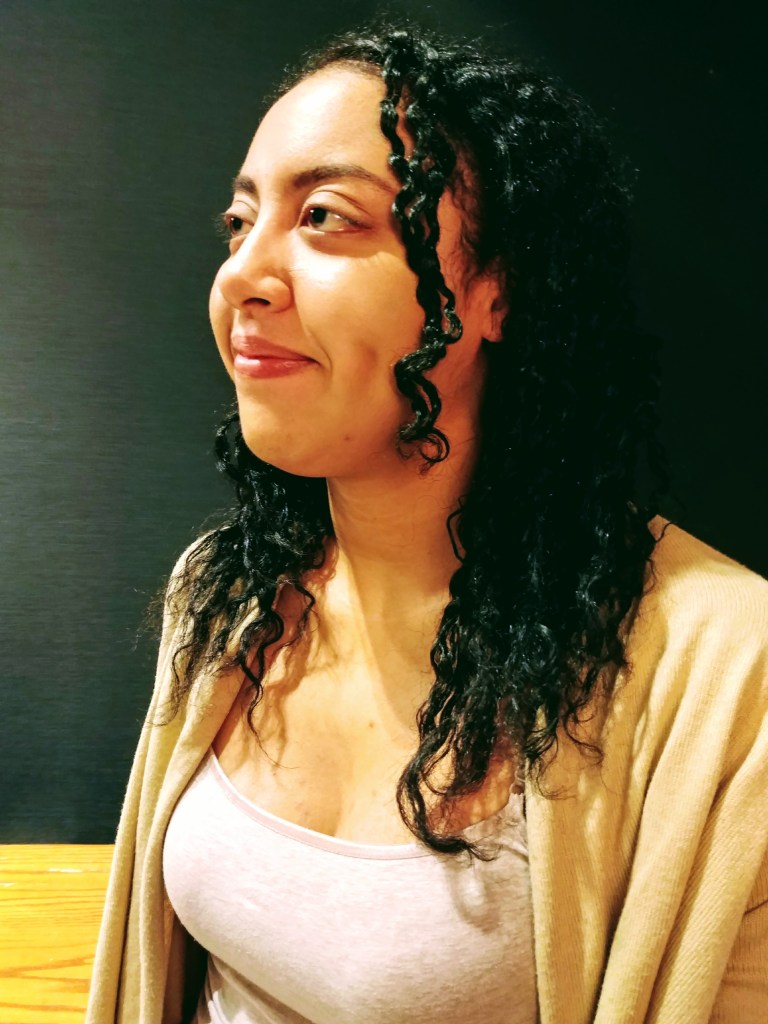
Barbara Sanchez
Age: 39
Occupation/field: Communicator/Writer
Why did you Decide to wear your hear natural?
It was not a conscious
decision. It was more a decision that I made overtime without being truly aware
that I had made a decision. My hair journey has been both painful and rewarding. My hair has always been an issue for me ever
since I was a little girl. The question of how to manage my hair was a big deal
for my parents when I was kid and began going to school. I had a little afro
from age four to nine. My hair didn’t grow down but up. I am mixed. My mother
was born in Jamaica and my father in Canada – with Irish and Scottish roots. My
hair was in between fluffy and wild. My Dad’s Dad had bright red hair and the
funny thing is that in my hair, I use to have one strand of solid red in my
hair (not anymore – too many hair dye jobs for me).
Over the years, I have gone
through many hair stages from relaxing my hair (the process of chemically
straighten hair to change the hair pattern to a softer more relaxed texture)
wearing it straight, blow drying and flat ironing my hair myself, and then in
high school I began to embrace my curls. From childhood my hair changed from
fluffy to spirally curls. As a teenager, I actually prayed for curls – and I
got them. In high school I become friends with a girl who had super curly hair
and she showed me some of the tricks or hair techniques that she used from her
curly hair routine. She taught me about hair mouse (it was the early 90s), how
to blow dry the hair and flip it from side to side and up and down to get
bouncy curls (thank you Georgia). This real life hair tutorial paved the way
for me to embrace my 3B curl pattern.
When I was in high school, I
use to straighten my hair and I remember a male class mate, said to me, “you
are trying to be white.” I asked “why do you say that?” “Because you straighten
your hair,” he replied. At that moment I realized the way I wore my hair was a
statement of my racial identity.
Much of my hair journey has
been shaped on the opinions of others. Some people say it looks better
straight. Some say it looks better curly. In the end, I chose to wear my hair
curly because it works for me. I like the flexibility of being natural and that
my hair does not have to look perfect before I walk out the door.
What
do you dislike about being Natural?
Right now my hair is in this
funny state where I am starting to get to know it all over again. It’s like we
just met and I have to figure out by trial and error a hair routine that works
for me because the products I’ve used before do not seem to be working. I find
the products are no longer managing my curls like they use to in the past. So
I’m kind of re-learning what products (leave in conditioner) works in my hair.
What
do you like about being Natural?
I like that it’s carefree.
Each hair strand can take its own shape and it’s cool. I really like the
texture of my hair. I often run my fingers through my hair. This is the number
one rule of curly hair – thy shall not play with thine own hair. But I am a
rule breaker of sorts. I like that’s it’s mine and that I’m embracing my true
self.
“I knew about my culture because I am West Indian, Antiguan but I did not pay attention to my blackness or the political statement my hair could make.”
Jua (name changed to protect her identity)
Age: 39
Occupation/field: Property assessment
Ethnicity: Antiguan
Ajax, Ontario
Why did you decide to go Natural?
I have always worn my hair natural for the most part. My hair is very
thin and I would occasionally wear weaves and braids for special
occasions but found that both would pull on my hair and result in hair
damage. Also the trips to the salon to get weave and braids done can be
both expense and time-consuming.
I remember seeing family photos of my Dad in the 70s wearing an afro
and dashiki. As a child, while in public school, my mom would braid my
hair so I think subconsciously wearing my hair natural was an evolution
of the positive images I saw of Black hair growing up. I knew about my
culture because I am West Indian, Antiguan but I did not pay attention
to my blackness or the political statement my hair could make. In
university, I would wear a small afro on campus and I was part of the
Black Students Association. I feel my relationship with my hair was more
about working with the texture of my hair and finding hairstyles that
would allow it grow and be healthy. Even though I wore my hair natural
for the majority of my life, it was less about making a political
statement and more about hair solutions that would not damage my hair. I
can remember my university days going to the mall with my girlfriends
(who also wore natural hair) and the looks I would get as we walked the
mall. The university was located in a small rural town in Ontario and
unlike the city (Toronto) was mainly made up of White people. I felt
that like maybe people thought we looked like a gang and it made me feel
criminalized.
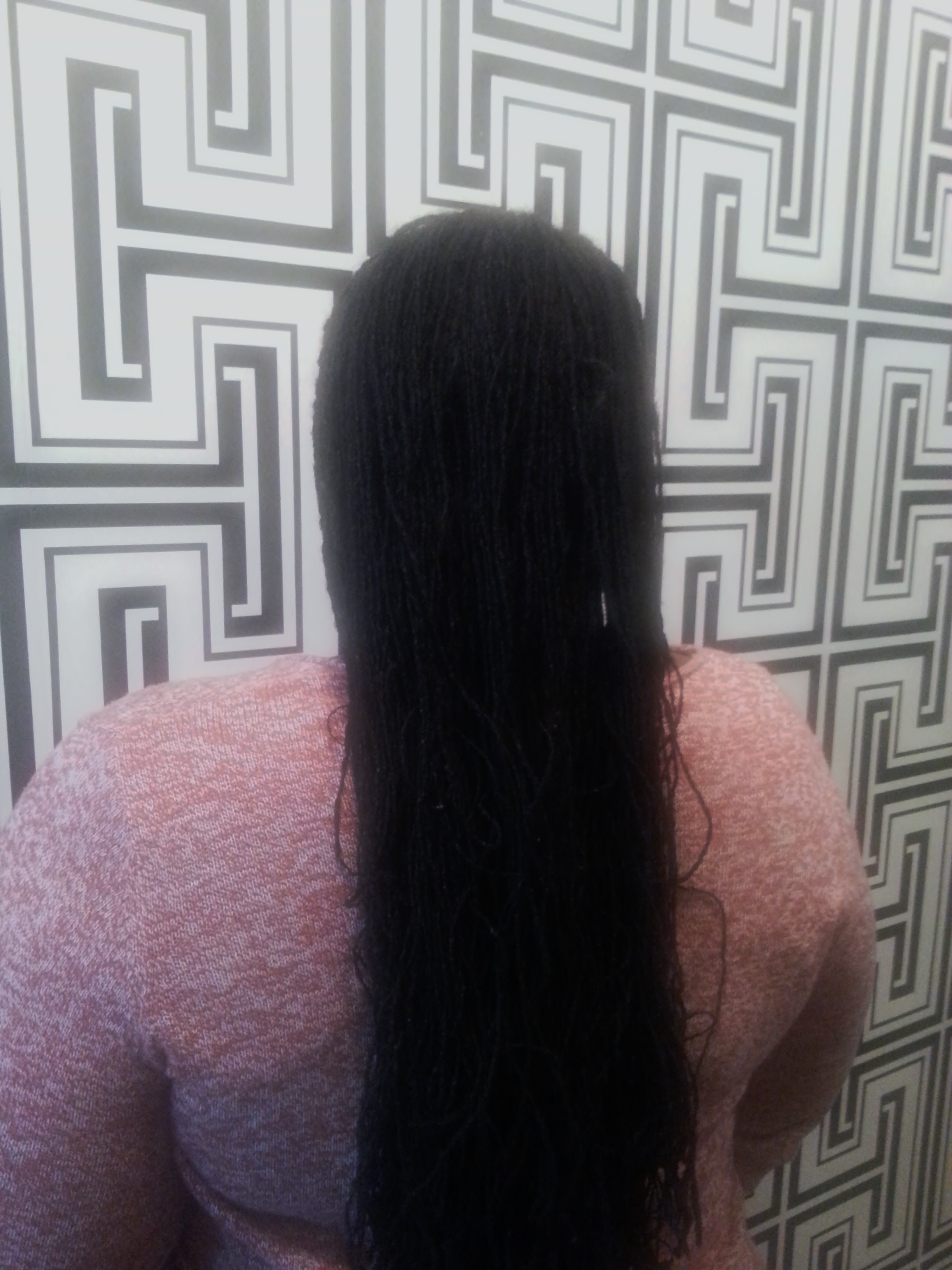
I decided to wear my hair in Sisterlocks when I got pregnant with my daughter. Sisterlocks is a hair style that results is the formation of small locs that are installed by a trained Sisterlocks technician as the style has been trademarked. The hair is transformed into locs, not through twisting the hair at the root like dreadlocks but by using a hair tool that resembles a crochet needle to form the locs in unified way. I did a lot of research and decided to get Sisterlocks because it was a low maintenance hair style that would allow my hair to grow.
What do you dislike about being Natural?
The unknown of how to manage your hair: I have five curl patterns in
my household and it’s hard to know how to take care and manage all hair
different types. My three daughters are growing up and are now
expressing an interest in wearing their hair natural and I struggle to
know what products as well as how best to style their hair. I feel like I
missed out on the traditions of how to maintain my hair so it stays
healthy. Also I feel my relationship with my hair is also tied to my
health. If I do not feel well physically and mentally on the inside it
affects my hair.
On a professional note, I did not realize the negative comments or feedback I would receive from co-workers at the office. When I got my Sisterlocks installed, I would wear a wig to work until my hair grew long enough that I could put it into a pony tail and then I stopped wearing the wig and would wear my natural hair. I remember when I started wearing the Sisterlocks to work, my hair was a lot shorter than it is now, and a co-worker sent me an email asking why would I cut off my hair? He said it looked so much better longer meaning with my wig. I was shocked that he (co-worker) felt that comfortable to send me this email considering we are not friends and do not socialize outside of the workplace. I realized when you think people do not care about how you carry yourself or decide to wear your hair; they always have something to say – good or bad.
What do you like about your hair?
I like that my hair grew and that I have long hair that dangles all the way to the middle of my back. My husband loves my hair and he braids it for me. It is a nice and relaxing way for us to connect and bond as a couple. I like that it is low maintenance in the sense that I am in and out of the salon to re-tighten the locks. My hair journey has taught me that I have always had a strong sense of self and danced to the beat of my drum by embracing my natural hair (before it was “in” or considered a movement). I realize even when you think you don’t know what works for your hair it will just take that one thing someone has learned from you to understand you have been doing you all along. I’ve had Sisterlocks for almost nine years and I am happy. I like what I see when I look in the mirror.
“People tend to blame society saying that we have to wear our hair straight because it’s more socially acceptable. I think that’s half true.”
Rachel Radford
Age: 23
Occupation/Field: Global Development
Home: Ajax, ON
Ethnicity: Jamaican/British/ Canadian
Why
did you decide to wear your hair natural?
It is too expense to
straighten on a regular basis and it damages my hair if I put too many
chemicals or products in my hair. I find if you just take proper care of your
hair it’s not too much to worry about hence why I am natural.
What
do you dislike about your hair?
Oh Gosh…after I wash it, I
comb it, I brush it and put it in braids and that whole process takes two
hours. It takes a lot of time and energy to maintain and care for natural hair
and that’s what I don’t like. My hair is awful in humidity and grows into an
even bigger puff ball. That’s the one think I am jealous about people with straight
hair. They can just put it up in a ponytail and go. There is a beauty supply(a.k.a.
Black hair ) store within blocks of each other in Durham region offering all
kinds of products, weaves and wigs because we have to spend more time and money
on our hair as women of colour.
People tend to blame society
saying that we have to wear our hair straight because it’s more socially
acceptable. I think that’s half true. Sometimes when I see an ad on television
or an article in a magazine, I see mixed race or women of colour in ads with
straight hair. Some think, oh that would look nice on me so it sparks your
consumer interest. I think it is much easier to manage if it was finer.
I always see hair tutorials
for girls with finer hair textures – White, Indian or Asian on how to blow dry
their hair straight and they just jump right into the heat protection
application and begin blow drying their hair straight and then using a curling
iron to add some curl or volume. For girls of colour – Black or mixed girls, they
have to take four to five extra steps to achieve the same look. For example, it
could be they had to relax it first, to reduce the kink in their hair, then
comb or brush it with a blow drying brush and then flat iron it to get straight
hair. And then, you can get into the curls by using a curling iron.
What
do you like about your hair?
I like that it is fluffy! My hair is not coarse- it’s thick and soft. It doesn’t get tangled too often. It usually grows super fast. The African Gold Super Grow product worked really well in my hair. To be honest, I am happy it’s curly! It’s not dull. I don’t have to worry about not having enough volume. And it keeps me nice and warm in the winter. I am not ashamed of my hair. There is nothing wrong with my hair. It’s a genetic trait. I’ve never been ashamed of either of my heritages as being mixed. It’s just how I am.
There is more to someone’s
racial pride than their hair. I don’t know why people obsess over it. I feel
like if you try defining people by their hair, it groups people together in
different classes and does not view a person for their personality or skill
set.
“The other day I was looking at pictures of me from high school and I was wearing my hair exactly like this today”.
Jarrelle Johnson
Age: 32
Occupation/ field: Finance
Ethnicity: Black/Guyanese
Why did you decide to wear your hair natural?
I was in university – I think it was exam time and I was wearing my hair straight at that time. It was just easier for me to wear my hair natural because it was cheaper than going to the hair dresser all the time. As a student, regular trips to the hair salon where not in my budget. So my hair dresser suggested I texturize (a chemical containing sodium or calcium hydroxide is applied to the hair for a short period of time, 10 minutes to loosen and soften the curly) my hair to reduce the amount of time it took to straighten my hair. Many people and their hair react differently to texturizers. For a lot of people, texturizers make their hair curly and softer. For me, my hair turned bone straight so it was like a relaxer (a chemical containing sodium or calcium hydroxide applied to the hair and left on the hair for a long period of time, up to 20 minutes to change remove the curl pattern from the hair and turning the hair bone straight). I had the worst reaction ever and I never did it again. That happened when I was 19. That was 13 years ago and I’ve been natural ever since.
The other day I was looking at pictures of me from high school and I was wearing my hair exactly like this today (natural). I was laughing at this picture because I’m so young and here I am how many years later and I look exactly the same – minus the wrinkles (there are no wrinkles what so ever! FYI).
I don’t know what my motivation was for rocking my natural hair back then because it wasn’t a thing like it is now. It wasn’t hot. There wasn’t a natural movement or any naturalistas. Natural hair was just saying I don’t have a perm (similar to a relaxer). Even if girls wore their hair natural, they were still going to the hairdresser to get it straightened. I wore my hair natural but never really asked myself why. I do not know if I was trying to be different. I was born in Canada but my family and I left when I was very young and settled in the United States. I went to a predominately white high school in California. I was the only Black girl in my graduating class of 500 students in 2003. So I didn’t really have to stand out with my hair. I already stood out. I know I just did my own thing. I was kind of popular in high school because I use to dance and was in cheerleading. I liked the look of natural hair. I was inspired by musical artists like Alicia Keys and her braids and Lauren Hill and her locs and somewhere in between there was me and my afro. Being Guyanese, being Canadian, being Black in a Southern California politically, republican, very white neighbourhood with old money, I didn’t come from that demographic. I think when I was younger I tried to fit in and tried to assimilate and melt into that melting pot but from middle to high school, I realized, I’m not going to be that.
My mom is half Surinamian, half Guyanese. Her father was a Surinaimian, dutch. He was born in Holland but he immigrated to Suriname. So that’s one side. My Dad I would say he is fully Guyanese but there is a bit of some Bajan trickling around. My Dad’s side was a mix of eastern Indian Portuguese and Black. Both my Mom and Dad wore afros. My mom for my adult life wore her hair straight. I have always been on a quest for being very proudly Black. Especially in situations where it is not easy to be proud of being Black because you may risk certain repercussion for doing so. For example, I come from the corporate world and it’s not always acceptable to come to work with an afro or promote my Blackness because we are supposed to be ambiguous and blend into the corporate structure. It’s more of a melting pot to their culture rather than showing your individuality.
My mom only recently within the last three years became natural. So my natural hair journey is not necessarily coming from her. My siblings all use to wear permed straight hair but now they are mostly natural. I have four sisters and two brothers. My brothers also wear their hair natural – my oldest has locs and my younger brother has an afro of curls. In my mind there was an image of Blackness for me. This image came from the world around me growing up in the suburbs and was reinforced by popular culture. The images of Black women that I saw growing up did not showcase Blackness but was more about blending in. Now it has kind of morphed into something completely different because Blackness really isn’t an image for me anymore – It is more than that. But at that time, as a young teen growing up, I think that’s where and who I wanted to be – unapologetically Black. I think that’s probably where it came from. That speaks to the 14 year old in the picture with the afro in school.
Growing up I didn’t really have much of my culture around me because I grew up in the United States and it’s very different from Toronto. In Toronto we can go to any corner and find something from our culture or any culture at that. In the States you can’t get that. It’s a privilege to find snippets of your culture if that makes sense. So I didn’t really get that and my mom was busy trying to fit in because we were all trying too. My mom couldn’t really fit in as seamlessly as I could because of her Guyanese accent and even among Black people we stood out. So imagine trying to fit into circles where you are the only Black person in the town you live.
Eventually my family and I came back to Canada in 2004 – I was 17. When I came back, I started meeting people that conveyed a different definition of what Blackness was to me. I started meeting other Guyanese people. Seeing what it meant to be Guyanese and then moving from that to what it means to be Black. What is the African diaspora? I took a trip to Africa twice. I went when I was 21 and when I was 23. Disclaimer: I was dating a guy at the time. He brought me home to meet his mother. The trip was so eye opening to me and I experienced a culture shock. In Africa, I went to Cameroon and Morocco. Just being around or in the culture and seeing what they like and their trends, their beauty practices – everything just threw me. There was such a high Eurocentric influence on their beauty practices such as bleaching their skin that I found quite disturbing. There were a lot of amazing moments and a lot of really sad moments that I witnessed. Coming back from that trip it helped widen my definition of Blackness. I realized that you could be that personified version of Blackness that you strive to be without having to be the afro toting Black girl. The hairstyle does not determine one’s Blackness. It really doesn’t matter and that was my take away from the experience.
What do you dislike about your natural hair if anything at all?
I’ll be honest; I fight with my hair every day. I just came back from Cabo and that was eye opening because I was struggling with my hair everyday thinking of how am I going to style my hair today? Do I braid it? I hate braids because they always wreck my hair. I find that the braids pull on my hairline so I realized I don’t want to do that just for a week of vacation. Then I said to myself… you know what just wear your hair out…whatever! I found myself constantly washing my hair due to all the chlorine in the pool. What a nightmare. What I’d say I dislike about my hair is the labour aspect of it all. It takes three hours to blow dry my hair straight. It takes me two hours to style my hair if I’m wearing it curly. It is a lot of work and labour that is required but I wouldn’t change it. I just wish that I wouldn’t have to spend so much time on my hair. There is no such thing as wash and go for curly hair. It doesn’t exist.
What do you like about your hair?
I like the versatility. I like knowing that there is always an option for me to style my hair. When one way is not working out, I have an alternative. For example, I straightened my hair and then it turns into a humid day my hair starts reverting back to curly, now a new style can emerge from that. I may get frustrated and tired with the process of styling my hair but there is always an option.




 Diverse Women Collective